Watch
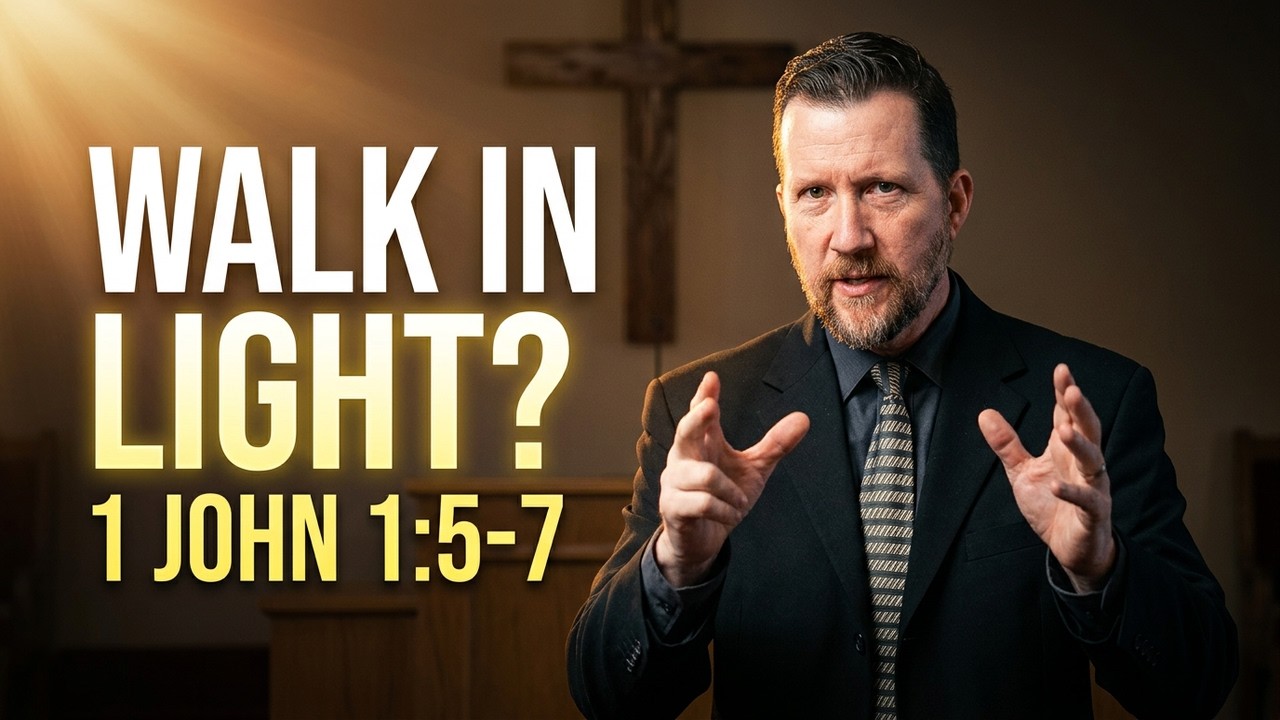
About This Message
Pastor Johnnie Sloan explores 1 John as a tool for examining the authenticity of Christian faith. The sermon emphasizes that true Christianity requires more than sincere belief—it demands visible transformation and consistent practice aligned with God's truth. John's central message declares "God is light," meaning morality, knowledge, and truth. Genuine believers walk in this light through fellowship with God and others, while those claiming faith yet living sinfully are exposed as liars. Salvation assurance comes from practicing truth and seeking forgiveness when failing. The sermon stresses direction over perfection: authentic Christians desire holiness, hate sin, and pursue God's light rather than darkness. Walking in the light produces cleansing through Christ's blood and unity with fellow believers in truth.
Transcript
If you have not already, please turn in your Bible to the book of 1 John. Everything in me wants to check the wiring of the audio. That's the way I am at home too. I have perpetual ADD. I run from project to project. So last week we began our series in 1 John, our expository series. Probably the way I'm handling this book will be what you wish I would have done with the book of Hebrews where we literally go verse by verse, line by line, even breaking up lines individually. But this is ...
If you have not already, please turn in your Bible to the book of 1 John. Everything in me wants to check the wiring of the audio. That's the way I am at home too. I have perpetual ADD. I run from project to project. So last week we began our series in 1 John, our expository series. Probably the way I'm handling this book will be what you wish I would have done with the book of Hebrews where we literally go verse by verse, line by line, even breaking up lines individually. But this is our second message and we already handled the introductory material that John is indeed the author. And the main subject, if there is a single subject, if you want to talk about the overall theme of the book of 1 John, it is genuineness of Christianity and genuineness of Christians. What is a real Christian? What is real Christianity?
And I said this before, but I don't want to give too much leash. I don't want to say the wrong thing and say more— I don't want you to hear me saying more than I'm saying. So when I say that the book of 1 John suffers less from decontextualization than other books, I don't want you to think we're free to decontextualize the book of John. So what I mean by that is if you take, for example, the book of Proverbs, the book of Proverbs, you can almost open up to any section of the book of Proverbs and read any 4 or 5 verses and get a nugget of truth and wisdom that by itself will be sensible. You'll understand it. You'll be able to use it. That's just the Proverbs are sort of designed like that. They're designed— they're proverbs. That's what a proverb is.
But there are other books in the Bible that if you jump into the middle of the book, if you jump into any particular section of the book, and you try to read a verse by itself in that section, there's a chance you won't get the meaning of that verse or a couple of verses because you have not seen the overall context of the book. And there's books that suffer worse from that than others. I often think of Ephesians and the poor children, the children of the church who are told over and over again to honor their father and mother, right? That you have to obey your children, obey your parents in the Lord. And they're hearing from Ephesians 5 and 6 over and over and over again, but they haven't heard 1 through 3. And the idea of Christians being what they are in chapters 1 through 3 that help you with 5 and 6.
Well, 1 John has a lot of verses in it, individual verses in it that can and are able to be understood by themselves. As long as you're not missing Christianity in general, as long as you understand the faith to some degree, you won't lose the whole understanding of Christianity by using verses. So there are chunks of verses that by themselves are a teaching, like a proverb is. They're by themselves are standalone. They actually are understandable in their individual place if you take them out of the context. But I just want to make sure the big picture of 1 John, so that you understand the purpose of 1 John to some degree, is real Christianity.
So even though you might take a verse or two out of 1 John and say, well, this makes my life happy, this is a life verse for me, that is not how you're supposed to use 1 John. John is writing with the purpose— he'll say it over and over again, he has various purposes— but he's writing so that the people reading the letter of 1 John would know whether or not they're the real thing. It's a test of genuineness. It's a test of actual faith or not, whether you actually believe in Christ or not, whether you have truly been born again, whether you are a Christian.
So when we go through 1 John, though you can take a verse here and there, a chunk of it here and there, make sure you understand the overarching principle is John is saying, do you want to know if you're a real Christian? Then listen to what I'm about to say. Do what I'm about to tell you to do. Understand what I'm about to have you understand. That's how you'll know if you're the real thing or not. It's as close to a diagnostic test as you will ever get in the Bible for real Christianity.
It's as— I think of voltmeters all the time because, I don't know, I don't know why I pick a voltmeter. It's the only kind of meter I use. I don't work on cars, so I don't know how to use the timing light thing. I have used the car computer, but I do what everybody else does that isn't a mechanic. I get the code and then I Google the code. I don't know those codes by heart. I've never ever used a thermometer in cooking. I don't know what you ladies are doing with those things. I don't understand how you can put a thermometer in a chunk of meat and know whether it's done or not, okay? Those are not my things. But the diagnostic tool of Christianity, if there is a meter to measure whether you're a Christian or not, it's the book of 1 John. You open this book, you're going to find out if you're the real thing or not. And I'm going to tell you, if you find out you're not, change and be the real thing. And that's what John will help us do.
There are indeed marks of true and false Christianity. It's not popular to say that in our day. In our day, it's not popular to say that somebody might be false or not a true Christian. People will think of you as unloving or uncaring or not compassionate if you label somebody as not Christian, you're divisive, you're mean, you're unloving. And then you come out and you say something like, I think you have to believe Jesus is a real Christian to be called a Christian. The audacity of saying you have to believe he was a real human being to be called a Christian. Well, John is going to say that. If anybody says that he didn't come in the flesh, he's not a Christian.
But half of our modern Christianity and the things that people are all into right now, you see it all over the world in social media, people are talking about being Christian and what they mean by that. Is they've adopted a lifestyle that looks like Christianity has taught over the years, but they don't believe Jesus is real, that he was a real person, somebody you bend your knee to and worship. So we can call something Christian and have contradictory thoughts about it. Or holiness, we don't talk about holiness. Oh, heaven forbid you tell somebody that when they walk through the doors of a church, they are unholy and need to repent and become holy. That's not popular. You're going to discourage people. You're going to hurt someone's feelings. Well, the Bible says it pretty clear: without holiness, you won't see God.
So these are things that John is going to outline for us as we unpack the book of 1 John. He's going to put these things straight for us. That truth is a non-negotiable. That truth is real. That there is a real thing called truth, and it's not up to you what you think it is. That faith can be genuine, and it doesn't have to do with the sincerity of emotions you might have. Like, you can sincerely want to believe in Jesus, but if you have the wrong Jesus, your sincerity means nothing? You can be sincerely wrong. You know this, right? You can be very sincere and still be sincerely wrong. I can sincerely think that McDonald's is good for me. I can be very sincere about that, but that doesn't make it true.
So there are genuine tests of the Christian faith, and the ultimate test is not whether you're happy or not. God's primary concern is His happiness, not yours. You're supposed to be happy when He's glorified. And John will help us understand that, that true happiness is walking in truth, in light, being close to the Lord, knowing He is pleased, knowing He is magnified. That's supposed to turn into us being satisfied. I did what I could do to honor and glorify the Lord, and Him saying, "Well done," is all I need.
Let's pray. Father, now as we again open the book of 1 John, we'd ask that John's words would be clear to us. It's hard to imagine this passage not being clear. It's so very clear. I'm, Father, certain that even the children in the room will understand completely what John is telling us here. But Father, however easy it might be, living it is a different story altogether. I think there's a lot of people who really should hear this. People in our world, people in churches, people in this church, we need to hear what John says here today. As simple as it is, it doesn't mean it's simple to put into practice. So help us, Father, learn the lessons of the text, live the lessons of the text, that we would indeed walk in the light, because that is what Christians do. And we'll thank you in Jesus' name. Amen.
Well, John has already given us his introduction in verse 5, and I'm gonna do the thing where I parse the verses I was going to say verbs because you parse Greek verbs, but I'm not going to parse verbs. I'm going to parse the verses into chunks. If you look at verse 5 with me, John says, "This is the message which we have heard from him and declare to you, that God is light and in him is no darkness at all." So John— I'm going to break this down almost word by word today.
When John declares the gospel, there's a side note. Let me get just a little bit theological, okay? Can I get just a little bit technical? Depending on the circles you run in, I don't know, the kind of people you're hanging around, some people will say the word gospel and mean the whole Bible. I don't know if you know that, but a lot of people, if you say the word gospel, in their minds that is synonymous with all of Scripture. There's nothing wrong with that. I don't necessarily agree with it, but I do want you to know that when I say the gospel, I primarily mean the good news that Jesus saves sinners. The good news of salvation. So I just want you to know, if you come from a background where gospel means the whole Bible, and also, by the way, if you come from a background where gospel can only mean salvation, you have to be careful there too, because there seems to be some language usage where the things kind of overlap.
So technical thing, when I say in the notes here the gospel is full and declared, I don't mean the Bible is full. I mean the news that John is delivering to the people is the news that Jesus came and his teachings that he gave when he came and when he died and he rose again. That's what he said in the last 4 verses, that they handled and touched and they spoke to Jesus. They experienced in real life the real person Jesus. That's the first 4 verses of this book. And now he's saying, that is the first 4. We're telling you the truth that Jesus came. And now we're telling you that has implications. And those implications first are, this is the message which we have heard from him and declare to you.
The word message here is important. There's actually 2 forms of the word message in the same verse. You see it says, this is the message. And then it says, we declare. That word declare also has the word message in it. And you know that word. Everybody knows that word. What's that place called the City of Angels that isn't much like a city of angels? Los Angeles, right? Well, the Angeles part of that means angel. You know that. The City of Angels. But the word angel doesn't mean the thing that flies that has the bow and arrow thing for Valentine's Day. The word angel is messenger. That's the meaning of the word. Angel. An halas is the noun form of it. The euangelion in the New Testament, that word is the good message. But I want you to know that the last half of that, or part of that, the angelion part, can have other prefixes too. So by itself, it can just be an halas, the noun. It can be euangelion, the noun that is the good news, the good message. But it can also be epongelion, which is a forward message, which is a promise. And in this one, it's one of the first times I've ever gotten to look at this word in Greek, is the anangelion. So Jillian's excited about that, the anangelion.
So the message, the first message in verse 5 is the message, the angelos, the message, the words, the message. But the second part of it, when he says it's a declaration, It's more formal, like a report. So what is John saying? This is the message. This, what I am giving you right now, is the message. It is the evangel. It is the message from God, and it is the message that we heard from him. We heard this message from Jesus when he was here, when we touched him and when we walked with him. We heard a message, and now we are reporting that message to you. That's what John is saying here. So we got the message, we're giving the message. Report, speak, tell— that's the anangelion here.
Do you want a paraphrase for this? This is as close as you're going to get in the New Testament to "Thus says the Lord." That's what John is doing here. What I'm about to tell you is what Jesus told us. We're going to relay to you what Jesus told us. It reminds me of what Paul does in 1 Corinthians when he says, I deliver to you that which, you know, in the communion passage, I'm delivering to you what I received, the message I received that Christ died for our sins, right? So this is like that. John is saying, what I'm about to tell you is a direct word from the one that told it to me. I heard him. I'm going to give it to you. And you, Christian, the audience of 1 John, had better hear it from me.
And what is that message? The first part of that message, you see, is that God is light, and in Him is no darkness at all. Now, there's a couple of technical things here, some semantical things I want to handle because I'm going to forget to say it if I don't say it right now. I want you to know that the first thing is he says that we have heard from Him. I think the Him there is Jesus because what happened before that is the one that they walked with, right? You can see, I think it's back in verse 3. Where Jesus is named in verse 3. So that's the nearest antecedent. So this pronoun "him," I think, is referring to Jesus, because that's who John heard it directly from. But now he has this little bit of a turn where he says that God is light. So I think what happens after the second half of verse 5 is referring to the Father. That's not crucial. There's no doctrine that depends on it. I'm trying to do diligence. I'm doing my work. When I'm exegeting the text, I want to be faithful to the text. So here, the idea is that God the God, probably the Father, could be the triune Godhead. But whatever he means, he does shift the attention from the one physically he walked with in time to now God in general, the idea of the Almighty, the Theos. That God is light and in him is no darkness at all.
Now when it says God is light, this is important because this John is also going to say God is love. And we want to be really careful. This is such an easy error for us to make. Humans do this all the time. I'm sorry I say it all the time. I know you're tired of hearing it. I'm kind of tired of saying it, which is that God created man in his own image, and then man returns the favor. Here's what happens is that man is always trying to see God in light of creation, but there's nothing in creation that is like God. So you have to be careful not to project creation back on God and make God like creation.
So when the Bible says God is light, it does not mean he's made of photons. It does not mean he is like this stuff coming out of these LED things right here. Incidentally, people don't even know what light is. That's a whole other discussion. But I do want you to see it says he is light. So if it doesn't mean he's made of photons, he's not the same stuff like shining on those leaves out there, then what does it mean? Well, it's an attributional statement. It's about something he is. It's about his being. It's an attribute of God that he's light. And this attribute has to do with moral. It has to do with intellectual, believe it or not.
Light is associated with intelligence in the Bible, knowledge, understanding. Light exposes, but light is also transparent, meaning that when you are walking in the light, you have nothing to hide. You're ready for the X-ray of the Lord's eyes. You're not hiding anything. So light is a very functional word that gives us the understanding that, first of all, light is pure and good and moral. It has to do with moral excellence, stuff that would be in line with God Himself, light. It's also intellectual, intelligible. It has to do with knowledge. It has to do with understanding. When you have light, you are enlightened. You know things. You're not ignorant. It's the opposite of ignorance is knowledge, light. And then lastly, light exposes. Light exposes darkness, but light also makes us transparent. In other words, if we shine the light on ourselves, we're not afraid of the light. We're not afraid. We don't need to hide in the darkness.
So light has that aspect of exposing. So when the Bible says God is light, that's what it means. It doesn't mean He's bright and shiny, although it means that too. It's always a little bit disheartening. I find people find that look on their face when they hear the concept of Shekinah glory, the shiny glory of God, the refulgence, right, as Dr. Sproul would say, the shininess of God at the Transfiguration. And they talk about the Shekinah glory. And then you find out and your feelings are hurt that that word's not in the Bible. The word Shekinah is not a Bible word. It just sounds nice. It's a nice name. People even name their daughters Shekinah thinking it's a Bible word. Oh, what a sad thing to do that and then find out it's not even in the Bible.
So that idea of light, of brightness, of refulgence, it could be physical. When Jesus at the Transfiguration unveiled his glory in some sense, those guys there, they saw it. They saw it with their eyes, so there was some element of it that was visible, right? It's not only invisible. So all of those things put together give us some kind of functional understanding of light. But then the next thing to know is that God is light, not photons, but all those things, and in Him is no darkness at all. This is why it's completely safe to say that nobody in sin or in darkness can stand in His sight. Because his light would just destroy them.
Now think of everything I said about light and then look at the opposite. What's the opposite of moral? Immoral. What's the opposite of intelligible or intellectual or wisdom or knowledge? Ignorance. What's the opposite of being happily exposed by the light? Hiding in darkness. Isn't it interesting, even still this far in the game, 2026, 2,000-plus years after the time of Jesus is that there are no day clubs. They are still called nightclubs. Why? Because humans are still ashamed of sin after all these years. They say they're not, but they still do most of the ugly things in the dark because they're trying to hide. They don't want to be exposed. So God is ultimate truth, ultimate moral, ultimate knowledge, ultimate standard, to expose. God is all of those things, and in Him is no shadow of turning. There is no darkness in Him at all.
Now, verse 6, this is where it gets practical. I'll just read the whole verse and then we'll piece it, parse it, look at it in pieces. "If we say that we have fellowship with Him and walk in darkness, we lie and do not practice the truth." So God is light, there's no darkness in Him. And it's possible that we who name the name of Christ, we Christians, we who say we're Christian, notice it says it, it says it so clearly, if we say we have fellowship with Him. So first, before I get into the implications of what comes next, we can say we have fellowship with Him, right? So it's pretty crazy if you think about that, that sinners at all, whether they mean it or not, can say they have fellowship with Him. Just even saying that, saying that we can say it is weird.
If we say, if we speak, if we talk that we have fellowship with Him. Now, you've heard this before. I know you have. You've heard people outside of the faith, and I've heard it a lot inside the faith too, where people see the hypocrisy in Christians. They see it, like whether they worked with them at work, but that Christian at work, like I have an example of this in my own life where I was working with a man who claimed to be a Christian. I didn't know, by the way, he was claiming to be a Christian. I didn't know it until someone else invited me to church. So there I was, an unbeliever working, and a friend at work invites me to church. By the way, him and Ken Simmons I attribute with sharing the faith with me so that I got saved. Some of you know Ken Simmons. None of you would know Philip. But Philip would share the faith with me, and he would bug me and bug me. And eventually he's the guy that said, "Well, you said you would come to my church sometime, Johnny." And he got me, because I did say that. And so now to keep my word, I visited his church. That's when God strangled me and got a hold of me, and I was never to go back.
But Philip invited me to church. The other guy at work, I won't name him, he's in heaven now. But when he found out that Philip invited me to church, he asked me why I never went to his church. Now, beside the fact that he had never invited me, do you want to know why I wouldn't have assumed he went to church? Because we would be doing jobs, like we would work overtime in the football games and stuff at work. And he would be drinking beer in the college vehicles, looking at women while we're at work. So why would I assume that guy was a Christian? Do you know what he did though, once he found out I was invited to another church? Verse 6, he said he had fellowship with the Lord. I didn't know that before because now I know he was only saying it. Now later in his life, he had a real shift of behavior. But in that moment, he said he had fellowship with him. His testimony after he found out I was thinking of going to church. So what do I think in that moment? What a hypocrite, right? That's what I think. That's what everybody thinks. Rightly so.
Just so you know, judging is also something that Christians do and say they're fine with the Lord when they do it. So be careful to think, yeah, I know Christians like your buddy at work that do that thing and are hypocrites. Be careful because you might be the judge of somebody else that is also guilty and saying you're a Christian and not acting like one. But the point here is that you can say you have fellowship, and we'll find out that that doesn't necessarily jive with truth.
Second side of that is that we can have fellowship with Him. I already said this, and I'm going to say it many more times in this series probably if I remember, that the word fellowship is not the way we mean it colloquially in our language. The way we use the word fellowship, hanging out, enjoying each other, companionship, friendship, being with acquaintances, enjoying time together. That is not what the word means in John's context. Fellowship is the Greek word koinonia. It's where we get communion. So if we say we have a common unity with the Lord, that's what he's saying. He's not saying if we hang out on Saturdays and barbecue together. That's not the depth of what John is saying. If we say with our words that we have actual unity and oneness with God Almighty.
Remember when Jesus says, He's praying in John 17, that I pray, Father, that they, the disciples, would be one with us as I am one with you, that we might have, they might be one with each other and with me and like I'm with you, like the unity the Son has with the Father, you can see that in the word fellowship. It is not a flippant understanding of fellowship. It means somebody that has a genuine communion with. So if somebody says they have fellowship, communion with the Lord, if somebody is using the words to say, "Jesus is my Lord," they can say it. Anybody can say it. Anybody can say they are Christian. I guess I'm asking you, is it true because you say it? I can say I'm a genius. I mean, I kind of do say that at my house, but do you think anybody believes me? I can say I'm a superhero. I can say I'm an athlete. I can say I'm strong and powerful. I can say anything. But here the idea is saying you have a communion with the Almighty.
And then it says, "If you say you do and walk in darkness." Now I want you to notice this, please. Please notice. It is possible to say you are a Christian. And walk with the one that was just said in verse 5 to be light, one in whom is no darkness at all. It is possible to say you have fellowship with one who is light while you walk in darkness, meaning there's nothing that has to keep you from saying it. That's really important, 'cause in our minds, I don't think we really grasp the idea that people can just outright walk in darkness and say they're a Christian. And that, as a matter of fact, disqualifies them from being called a Christian. We don't want to ever disqualify anybody from being a Christian because we feel too judgy when we do that. We feel critical when we do that. But it does say walk.
Now I want you to put the word walk in your pocket. The word walk in the Bible, and I don't know if John really means it here. I might be pressing John a little bit, so be patient with me. I don't want you to accuse me of abusing Scripture. But I am going to say the thing, and that thing that I'm going to say might apply to John's words. Not 100% sure it does, but I'm going to say it anyway, that walk in the Bible is an idiom. Walking in the Bible is not just the verb of mobility, not just movement. Walking in the Bible has the idea over and over again of progress and growth in the faith, always. Can the two walk together, the Old Testament says, unless they be agreed? Right? Who walked with God. Abraham walked with God. Noah walked with God. This idea of walking is a biblical idiom. We walk by faith. That's a problem, by the way, with the NIV. It translates that wrong. It says we live by faith, but the word is peripateo. It's walk. So the idea of walking in the Bible, you can't walk in place. There's no treadmills in the Bible. Walking always is progress, movement. This is why you can't walk in the path of sinners. 'Cause if you're walking in their path, that means you're going where they go.
So walking is motion, walking is progress. In this case, it's regress. It's backwards walking. But I want you to catch it in your mind. It is possible for your words and your feet to not be doing the same thing. It's possible for you to think and say that you walk with the Lord, but your feet are not walking with the Lord. You can be self-deceived. Or just an outright hypocrite. The question would be right now is, do the people in this room understand that about themselves? That we can say we're walking with the Lord while walking in darkness. We're capable of it. Now, we know unbelievers can do it, but do we know that he's talking to us Christians? This is the test of Christianity, that there are Christian professors who say they walk with the Lord, they profess a walk with the Lord while they walk in darkness.
So walking is action. It's movement. So you can say one thing and do another. If we do that, if anybody says— I do want you to catch it. He says, if we say— who's the we? Christians. If we who profess to follow Christ— he's not talking about the outside world. He's saying if we who profess to follow Christ, if we say we have communion and a unity with him, and we who say it walk in darkness, At the same time we're saying it, we lie and do not practice the truth. That's what he says at the end of verse 6. How plain can John be and this not make sense to us? Do you know how many times over the years, over and over, I've even heard people use 1 John to do it, to tell somebody who is not walking with the Lord at all, to tell somebody who is literally living in darkness, somebody who's living in addiction and adultery and every other thing, and somebody wants to make them feel better and make them— they have noble goals in trying to bring the comfort of God in their lives, and then they say, you can know you have eternal life even though your life is a complete hypocrisy and you're not walking with the Lord. I want you to know from 1 John 5 that you have eternal life. But how plain can John be? If you're walking in darkness, you're a liar if you say you have eternal life. How clean and clear and perfectly understandable can he be?
When he says lie, it's where we get any word that starts with pseudo. It's pseudomai. It got me. I need to call my Greek professor, Dr. Walker, this week. Because I got caught with a deponent verb, and those used to mess me up in school, make me get bad grades. Because a deponent verb looks like a middle voice verb, but it's an active voice verb. Oh, those things were the bane of my studies, man. And this one almost got me. But what that means here in this context, pseudomai is the verb. And that sounds like a middle voice verb, but it's an active voice verb. What that means, if I were to translate it, if we say we have fellowship with him, but we walk in darkness, if you want to put it in its most literal form without trying to keep the words condensed, we are lying. Present tense reality. It doesn't say we told a little fib. It's essentially saying if we say that, we are currently, presently, as a matter of action and lifestyle, liars. We don't like to call ourselves liars, but that's what it means. And then it goes on to say we do not practice the truth. Now, do you notice it doesn't say— please notice carefully what it doesn't say.
It says if we say we have fellowship with him with our mouth, we say we have fellowship with him, join common union, and we walk in darkness, our actions, our progress is in the wrong direction, we're walking in darkness, not in the light. It says we lie. And then notice what it doesn't say. It doesn't say we lie and do not believe the truth. Did you see that? Did you see it, you good Baptists? I think Jillian's the only good Baptist because she's responding right. We lie and do not practice the truth. Does everybody see it? I thought all that matters is that you believe in Jesus. Isn't that all that matters? You need to stop saying you have fellowship with him, and instead of just saying it, really, really believe it with all your heart. As though believing in Christ is only something you do in your heart or with your voice. No. Walking. Practice.
The word for practice here, I love this word. It's the word poieo. It's where we get the English word poem. And you may say, well, what does a poem have to do with practicing? Because you make a poem. A poem is a thing that's made from words. It's a conceptual idea of making something from words. Poem, the word poieo means to make something. It's in the Bible a lot. It's in the New Testament. So many times you'll see the word do or the word make. That word is the idea of produce. So the idea is we are liars and we are not producing a life that's in accordance with the truth. There's a product. It's visible. So John is being very much like James here, saying if you say you have faith, but you don't have any works, can that faith save you? No, that's not a real faith because the real thing isn't merely words. It's action in your life.
God never leaves someone in the same place when He touches them. If God touches you, you do not stay in the same place. You can't say the Almighty that spoke a universe into existence touches you and you not change. So if we say we have fellowship with Him, communion with Him, unity with Him, but we walk in darkness, We might say it. We can say all day long, I'm Christian with a capital C. I'll put it in calligraphy. I'll make it— I'll carry a banner around that says, I'm a Christian, I'm a Christian, I'm a Christian. I'll say it louder than anyone else. I'll sing it from the mountaintops. Christian, me Christian. I can say it all I want, but if I walk in darkness, I'm a big fat liar. And I'm not practicing making a life in accordance with the truth.
So it isn't our profession only. When you confess with your mouth the Lord Jesus, that Jesus is Lord, that word Lord means he's your master, and you go where the master tells you to go. He's the shepherd. You go where the shepherd tells you to go. Nobody can say, I'm a sheep and I'm gonna be over here by myself and not go where the shepherd goes. Then you're not a sheep, you're something else. Maybe you're a goat, and not in the good way, the way the kids say it. There are no sort of Christians. You walk with the Lord or you don't.
Now again, I don't want to make exceptions because John isn't making exceptions. This is also John that will tell us that we can have assurance of our salvation later. But that assurance comes from a life that is lived the way 1 John tells us to live it. But right now, there are people apparently in John's day and for sure in our day that say they walk with Christ. They say they're Christian. They say they've adopted Christian principles. That they walk and have fellowship with Him. "No, I love God." I remember my neighbor saying that. "I love God." You have never talked to Him in your life. How can you say you love somebody you don't spend any time with? Nobody you have— "I love my wife, I just never want to talk to her. I love my kids, I just never ever want to spend time with them." How can you say you love God and not walk with Him?
Clearly, John is being very plain here. It's so clear what he's saying. Maybe I might be wrong here. The old cynic Sloan before I got saved might be thinking this. Forgive me if I'm cynical, but is it possible that the clarity of this bothers us because we like the excuse of not having to walk with the Lord? That we like the excuse that if I made a profession of faith or I prayed a sinner's prayer, that I think I should feel confident that I have a relationship with the Lord, and when I'm walking in darkness, that it's not really full darkness, it's just like the lights are dimmed and I'm not actually in darkness? Is it possible that the idea of it being so black and white that I either walk with Him and practice truth or I don't. It's too stark for us. It's too clean for us. It hurts too much. That maybe I want to think that there's a way I can have one foot in light and one foot in darkness and be okay with Him. Maybe. I hope that's not true.
Moving on to verse 7. There's promises associated with walking in the light. There's threats if you don't. It's scary to be called a liar from the Lord. Don't do that. But you walk in the light, you practice truth. You're not a liar, you're not a hypocrite, you're not pseudo, you're genuine. But by contrast, if we walk in the light as he is in the light, we have fellowship with one another, and the blood of Jesus Christ his Son cleanses us from all sin.
Now this is interesting. Every once in a while I have to break out my old Greek books and syntax books and the grammar, because there's a conditional here and you can see it in the word "if." Whenever you see the word "if," it's a conditional. In Greek— I don't want to get off in the weeds here, but Koine Greek, the Greek of the Bible, is more modern Greek than classical Greek. So Aristotle's Greek is not the same as Paul's Greek, okay? And Paul's Greek is not the same as modern Greek. So I don't know if you know right now, if you learned fluent current Greek and you could speak the language that they speak right now in Greece, you would understand the New Testament, but it would sound like King James English to you. So New Testament Greek is older than modern Greek, but New Testament Greek is also newer than classical Greek.
The reason I bring that up is because when I say there's 4 conditionals in Greek, I don't want somebody Googling that and saying, oh man, PJ's way off base here. I'm not talking about in classical Greek, and I'm also not talking about the practical use in modern Greek. Typically, everybody understands that in the New Testament language, the 1st century Greek, Koine Greek, the common language of the 1st century, there are 4 conditionals. And actually, only 3 of them are really used in the New Testament. There's one that's an optative conditional that you— that one's questionable because of whichever manuscripts you use. So the 3 conditionals are the if-then statements. If A is true, then B is true, or whatever. If A is not true, right? The conditionals.
This one is a third class conditional. And the reason this is significant, the reason I spend the time to say it. It's not the typical if-then proposal like you see in other places. Since, like normally you could translate if, since this is true, right? This is not that one. This one is not since it's true. This one is the third class conditional, which means the second half of it will be the most likely outcome. So if you see it, if we walk in the light, that's not a guarantee like it is in other conditionals. This is not saying, "Since we are walking in the light." This is very much the way we use the word "if." I mean, if my legs allow it, I'll be able to do yard work tomorrow. But how guaranteed is that right now? My hand hurts right now. PJ's hand is messed up, right? So my hand hurts. So if my hand will allow me to do yard work tomorrow, right? So there's some doubt in that. You can hear that, that there's doubt that my hand will let me do yard work tomorrow, right? That's kind of a third-class conditional. It's not a since, it's an if. Okay?
If we walk in the light as he is in the light. So instead of us saying we walk in the light and not walking in the light but walking in darkness, this is saying now, on the other hand, by contrast, if instead of you being a hypocrite and a liar, you are a truth-teller and you say you walk in the light but you actually live the light walk. Walk in the light. Do you notice it doesn't say if we say again? Did you notice that? In verse 7 it doesn't say again if we say we walk in the light. Here it's saying if we walk in the light. So in other words, if the most important test is the action, then verse 7 is saying if the action is consistent with the profession, even though the profession is not the important part, if we walk in the light and boy, I hope you do, is the implication, right?
If we walk in the light as he is in the light, then it says we have fellowship with one another. And again, now I think that he is the Father. Walk with the Lord, walk with God. It could be walk with Jesus, but I think it means the Father, and I have theological reasons for thinking that. So in this most likely future, if we know we're walking, It is possible, both sides of that are true, right? You all know this, that it's possible to say you're a Christian and then not live like one and be a hypocrite. It's also possible to have behavior, behavioralism, moralism, where you're doing Christian things and thinking you're a Christian and not be a Christian. That's also possible. But that's not what John is addressing here. He's addressing the people who say they are and aren't. So the profession-only people, people who are professors but not possessors.
I didn't make that up. Is that a J. Vernon McGee? I think he might have said that. If I say J. Vernon McGee, you got to use the accent, don't you? You can't quote J. Vernon McGee and not do the J. Vernon McGee accent. Professors, not possessors. Perfection, not direction. So, the other way, direction, not perfection. Only God is light. Now, I'm saying that carefully and with pause because Jesus will say you're the light of the world. Right? So we want to be careful to make sure that when the Bible says God is light, it means He's the source. Right? He's the self-contained light. It's an attribute of God. For us, it is something that happens after we've been changed and walking in the light. So we don't have light in us by nature. Since we've fallen in Adam, we're not enlightened, as it were.
But if we walk in the light, if our production, if our behavior, if our practice, if our poe-o, our actions are light actions, if we are actually walking in the truth and in the light, and remember, light is truth. Light is the moral truth of God. Light is the intelligibility of God. Light is the exposing of God. That's what light is. Light is not just mere photons. If we are walking in the light, which means walking in the truth, which means walking after God himself, being in alignment with him, being close to him, walking next to him instead of the fake stuff, the fake enlightenment, the fake intelligence, the wisdom of the world, Right? You can be smart. You can have degrees and be intelligent in the world, but not be Bible-wise, right? Remember when Paul says the foolishness of God just completely stumps the wisdom of man, right? The foolishness of God, that means the lowest light of God is higher than the highest light of man, right? That's the idea is however smart man thinks he is, the very best man can do doesn't even hit the bottom of God's simplest light, right? So we understand that.
But here he's saying if we walk in the light as he is in the light, this is qualitative, not quantitative. You cannot be as lighty. I know that's not a word, but bright or whatever the right way of saying that. You can't be what God is, but you can walk where God tells you to walk with him. You can do that and you can walk with him. You can say it, but you can also do it. Isn't that good news that we can profess to walk in the light and actually walk in the light? Right. So the opposite of the hypocrite and the liar is true, that we walk in the light as he is in the light. Instead of just pretending to be smart. And if I could paraphrase, if I could apply it, is if we walk in biblical truth— can I say that without stretching the text too far? If the truth isn't in us, that means the light isn't in us. But if the light is in us and we're walking in it, that also means we're walking according to biblical truth, to the light of God's Word. His Word is a lamp unto my feet. So this idea of light means we're not only walking in light as we feel light, our conceptualized ideas of light, but we're literally walking according to what God said in the light of His word and what He's illuminated us to Himself. We're walking with Him.
It says, "We have fellowship with one another." Now, that is an interesting turn that John makes here. So interesting because before he says, "If we say we have fellowship with Him," right? So if we say we have communion with God, if we say we walk closely with God, but we walk in darkness, then we're liars and there's nothing good in us. We're not practicing truth. We're not living the truth. But now he says if we walk in the light as he's in the light, I think it's beautiful that John does this. Says we have fellowship, communion, unity. We have in common a relationship with one another. I think that's beautiful. I don't know if you think it's beautiful. I think it's beautiful. I hope you think it's beautiful that we have fellowship with one another.
And the "one another" is a word that John likes to use. This isn't the full form of it, but it's "all alone," which I always find funny that the Greek word for "one another" is "all alone." That's one form of it. "All elous" is the main use of it. But it's one of the ways I always remembered that word because it's "all alone." Wait, no, with one another. That's what the word means. Now again, back to the idea of fellowship. Fellowship is not proximity. It's not acquaintance. It's not companionship. It's unity in truth. So can you and I have fellowship if we're not walking in truth? We might have fellowship, but is it fellowship in truth? So I appreciated Zach last week. He reiterated that idea, the idea of having the truth be in the center of our fellowship or community, the idea, right? That we want to have communion in the truth, not just in relationships with each other and what we have in common.
Because we can do that. We can talk about sports and food and I don't know, whatever you like talking about, and think we have fellowship. But we have fellowship in food then. Or we have fellowship in sports then. Or fellowship in politics then, if you like. I don't want fellowship in politics, by the way. You can have that one. But the idea of having fellowship in our mind, we just equate that if I'm hanging around Christians and I'm smiling, I must have fellowship. But remember, the word fellowship here means unity in the faith. We have in common with the Lord what the Lord thinks is important. What the Lord is doing on planet Earth right now is saving people and building His kingdom. So we have fellowship with one another. We're walking in truth together. We celebrate the truth together. We celebrate the light together. This is what we care about. I care that you're walking in light. You care that I'm walking in light. You care that my life would magnify the Lord and his truth, that I'm practicing truth. And you don't only care if I got a new car or what's happening on TV.
And then this last phrase is amazing because it also is a conditional statement: "And the blood of Jesus Christ his Son cleanses us from all sin." The blood of Jesus Christ his Son cleanses us from all sin. Hmm. It almost looks as though John is saying that only if we walk in the light does Jesus' blood cleanse us of our sins. And you say, well, maybe it's not a conditional in the original. Maybe it's not. Maybe it's something else. Maybe this isn't a conditional. I got news for you. It's a conditional. It's a conditional just like the other one is. A third-class conditional.
So what is it really saying? Is it saying that in order to have the blood of Jesus Christ cleanse us from our sin, we need to start walking in the light? That's not what it's saying. What it's saying is if we're living sinfully, we should not have the sense that we are cleansed by the blood of Christ. If we're practicing a sinful walk, we should not have the confidence that we are cleansed by the blood of Christ. That's the idea. So the idea is that if you are walking in the light, the probability is that the blood of Christ has cleansed you from your sin. Right? That's the conditional statement of it. It is not saying you must walk in the light in order to be cleansed from your sin. That is not what it's saying, that the cleansing depends on the walking. That is not what it's saying. But it could look like that because of the conditional statements.
The Greek word for cleansing here is where we get the English word catharsis. You know what that means, right? If something is cathartic, it means you've essentially purged yourself of it. You know, I had a very cathartic nap today. I was anxious when I went to lay down. I was upset. I had a headache, and man, I didn't feel great. And I laid down, and man, that nap was cathartic. I just cleansed myself of all that stress. Catharsis is cleansing. It's catharizo in the original. So the idea is, how do you know you have been cleansed by the blood of Jesus Christ from all your sin? How do you know? How can you be sure? In other words, what's the test? What meter can I put on my body? What probes can I put on my body? What X-ray machine can I put over my body? What scan can I get that would show I'm cleansed by the blood of Christ from all my sin? Well, that you have fellowship with one another because you're practicing the truth. It is the way we can know that we're right with the Lord and with each other by walking in the truth. By living it and walking in it.
And you say, "Wait a second, what if somebody says they walk with the Lord, but they're not sure if they are cleansed by the blood and they're still kind of living in the darkness?" Didn't John just answer that for us? How do you have assurance of salvation? How do you know for sure? What's the only test you need to pass in order to know you're cleansed? Again, not test you pass to get cleansed. Tests you pass so you can have the certainty of cleansing, that you know you walk with the Lord, that you know He's yours and you are His. One thing you don't do is say you're His and then walk like you're not. But the one thing you do is if you walk in the light, you're moving, there's some action, some progress. I was here yesterday, but I'm here today. Yesterday I had trouble with this sin, today I overcame that sin. I didn't fall to that sin today. I'm growing in my sanctification. I'm not habitually doing the same things over and over again.
You know what that sounds like? That sounds like somebody that's been cleansed of their sins. That sounds like somebody that's been changed. That sounds like somebody that once walked in darkness but now walks in the light. And that's exactly the Christian walk. And we need to stop muddying the Christianity of our day. Stop making it hazy and saying, well, if you just went to church when you were a kid, that makes you a Christian. If you just signed a little card at camp, that makes you a Christian. If you agree with the guy on YouTube, that makes you a Christian. No, you do have to say you're a Christian. You even have to profess your sins to the Lord. Confess. You have to tell him you're a sinner. You have to ask him to forgive you. You have to seek forgiveness and be forgiven by the blood of Christ.
But if that seeking and that happening in your life, if you ask the Lord to forgive you, if you ask him to indwell you with his Holy Spirit and you don't change, You might not pass the test that John just gave us. But if there is a change, if there's a nagging, "Oh, I don't want to be in sin anymore. I know that Jesus died for me. I don't want to live the way I used to live. I want to live in the way of somebody that's cleansed. I want to walk in the light. I love the light." That doesn't mean you don't fall on your face every once in a while and act like you live in Egypt. But you don't live in Egypt anymore. You don't love Egypt anymore. You're not trying to go back to Egypt anymore.
Back to J. Vernon McGee. It's not perfection, it's direction. If you fall, the fall is temporary. You're now not identified by your darkness walk. You love the Lord, and if you fail, it's a temporary failure. And you say, I hate that I'm acting like somebody that walks in darkness. I don't want to walk in the darkness. I want to walk close to Him. I want fellowship with Him, and I want fellowship with His people. My real heart is I want to follow the Lord. And I have failed. So what do you do when you fail? You ask for forgiveness. Guess what's coming next? You can look right, you can sneak ahead. I'll let you cheat a little bit. Look ahead to verse 9. It's right there in black and white. If we fail, how we handle the failure.
But make no mistake, if you're walking around in confidence that you're fine with the Lord while you walk in darkness, you're a liar. And may I challenge you, please walk in the truth. Tell the truth. Don't be a hypocrite. There's enough of those in the world. Can I say it? Maybe I'll say it this way. There's enough of us in the world. We need to walk in truth. Saturate yourself with the Word of God. Love the light. Don't love darkness. I love that passage where the Bible says that the Lord translated us out of darkness into light. That's a final statement. That's not a gradual statement. There's no statement that says God will let us linger in a dimly lit room. You're in the light. Now walk like it.
Let's pray. Father, we do thank you that we are able to walk in the light. We can say we walk in the light, and the lesson for today is that we would mean it when we say it. Would you help us walk in the light as you're in the light? And Father, if we are flirting with darkness, if we think it will satisfy to walk in darkness, would you help us? Would you work on our heart? Would you convict us in a way with mercy and gentleness to draw us back to the light? Help us. We know there's forgiveness. We know all of your promises are true. Oh, but Father, if there's any hypocrisy in it, in us, would you help us purge it? Because we really do want to glorify you, and we'll thank you for that. In Jesus' name, amen.
Downloads
From the Series
The Three Epistles of John
View all messages →
More from The Three Epistles of John
Related Articles
Righteousness
Today, with churches so bent on “breaking down the walls,” fewer and fewer people even know what ever erected them. Central to… Read More…
By William Heinrich
Read More →
Love Your Enemies
Christians who openly and unashamedly tell others of Christ will be very unpopular people. Therefore, to avoid the shunning and persecution, Christ… Read More…
By William Heinrich
Read More →
Christians and Lawsuits
In I Corinthians 6:1, Paul states, “Dare any of you having a matter against another, go to law before the unrighteous, and… Read More…
By William Heinrich
Read More →